 Acidulants
Malic Acid
Acidulant valued for smooth, long-lasting sourness across confectionery and beverages.
ConfectioneryBeverage
View Product
Citric Acid is one of the world's most widely used food acidulants, valued for its bright sourness, pH adjustment and versatility across beverage, confectionery, dairy and processed food applications.
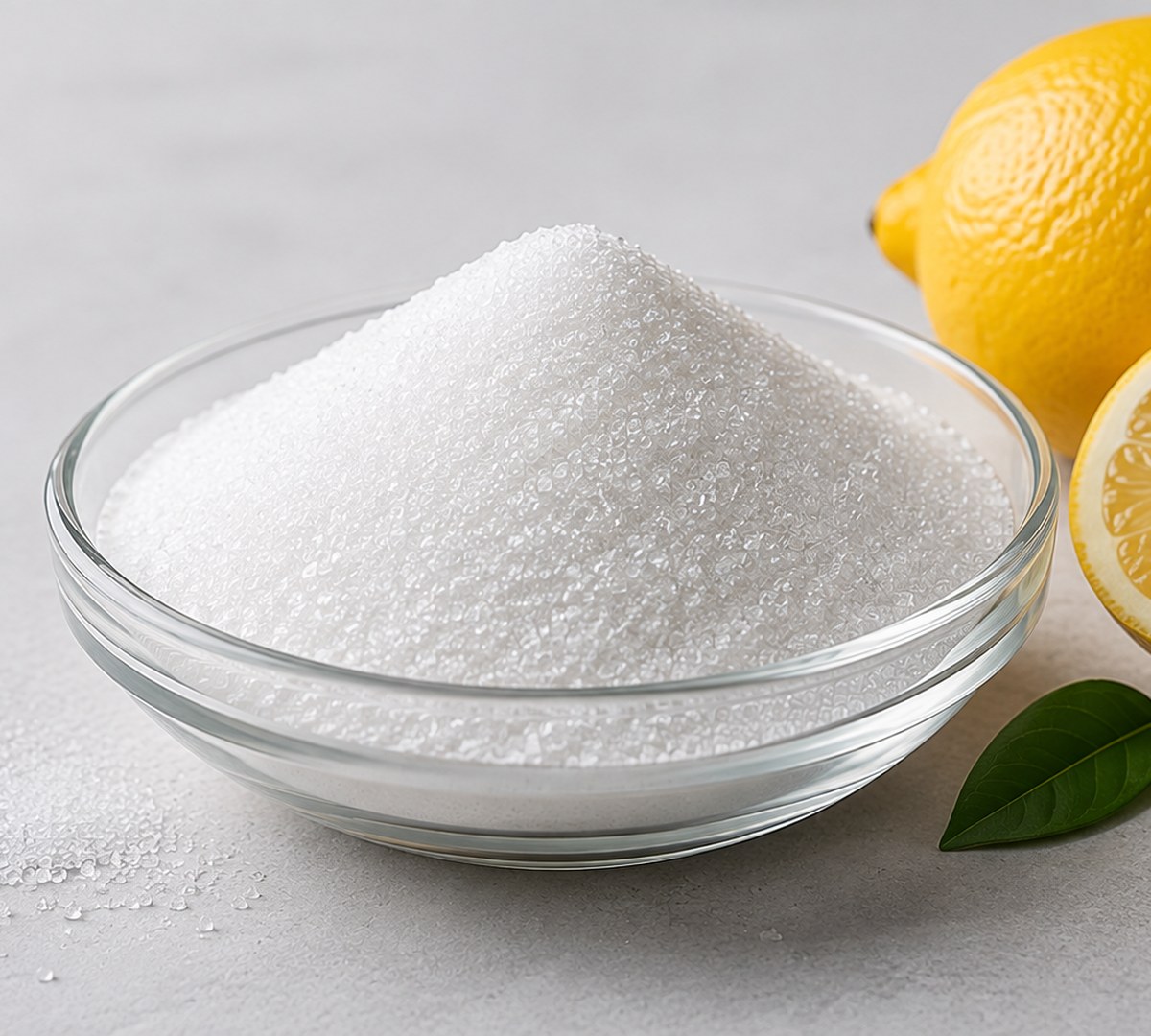
Citric Acid is an organic acid naturally present in citrus fruits and widely produced through fermentation for food applications.
In food manufacturing, it is commonly used to adjust acidity, provide a clean sour taste and support product consistency across a wide variety of formulations.
Its versatility makes it one of the most frequently used acidulants in the food industry.
For a more detailed explanation, visit our What is Citric Acid? article in the Knowledge Center.
Provides a fresh, clean acidic taste suitable for many food and beverage products.
Helps achieve the desired acidity level during formulation.
Supports overall flavour balance in many applications.
Suitable for a broad range of manufacturing processes.
Used across numerous food categories.
Provides reliable functionality in industrial food production.
Used in soft drinks, fruit beverages and powdered drink mixes.
Provides sourness in gummies, hard candy and other confectionery products.
Supports flavour development in selected dairy products.
Used where acidity contributes to product performance or flavour.
Applied in nutritional and specialised food formulations.
Rather than focusing on fixed specification values, Citric Acid is generally selected based on its functional performance within a formulation. Typical considerations include:
Detailed specifications are available upon request.
Depending on the application, Citric Acid is available in different grades designed for specific functional requirements. Typical examples include:
The most suitable grade depends on the formulation and manufacturing process.
Technical documents are available upon request, including:
*Availability depends on the selected grade and manufacturer.
Choosing the right ingredient involves more than selecting a product. At EMTA Kimya, we support food manufacturers with:
A vetted international supplier network that keeps quality and supply consistent.
Support in identifying the ingredient grade best suited to your formulation.
Technical documentation shared on request to support your evaluation process.
Sourcing arrangements adapted to your volume and production schedule.
A team that responds quickly when you're evaluating or placing an order.
Acidulants
Acidulant valued for smooth, long-lasting sourness across confectionery and beverages.
 Encapsulated Acidulant
Controlled-release acidulant designed for delayed acid activation and improved processing.
 Hydrocolloids
Natural hydrocolloid used for emulsion stability, flavour encapsulation and texture improvement.
 Hydrocolloids
Food grade hydrocolloid that improves viscosity, suspension and product consistency.
Whether your application requires flavour adjustment, pH control or acidification, our team can help identify the most suitable Citric Acid solution for your production process.